A team that shares one memory with its agents needs two answers for every record: who may read it, and who may change it. Mana takes the first answer when the record is written, keeps the second with the organization's admins, and keeps every version a correction replaces. Both choices have a cost, and the clearest way to see them is to follow one person into a team that already has a memory.
The team is Pellwick. Five people sell a web app that builds staff rotas for small vet, dental, and physio clinics. Ines founded the company and is its admin. Tom sells to clinics and clinic groups, Lena looks after the clinics, Maya designs the product, and Kofi runs marketing and the site. Since mid-July their Mana store has grown to about 150 records. Their agents (Claude Code, Codex, claude.ai, and ChatGPT) wrote about half of them. The rest are a handbook that Ines imported from a notes vault, and records she wrote from the command line.
Monday, before the first question
The new account executive connects claude.ai on Monday morning, signs in to Pellwick's organization, and puts the Mana rules in Instructions for Claude, as the claude.ai guide asks. Each chat then reads the house rules before its first answer. Answer in English, cite the handbook, and never put a clinic's staff or patient data in a prompt. Sales gives a discount only for annual prepayment or a group, and above a limit Ines decides. A group trial starts with the procurement pack.
Nobody prepared a welcome folder. Ines and Tom wrote those rules weeks ago, as group settings for their own agents, and Mana hands the organization's settings (the config/ records) and its highlight to every connected agent that asks for its standing instructions, as far as the person may read them. The rest of the store is there for the agent to search: the lesson Tom stored the day a physio group was lost, the decision that a clinic group pays one price per site.
Some records stay out of reach. The agent cannot read Ines's idea of locking a group's price for two years, which she keeps to herself. It cannot read the Product team's idea of importing a paper rota from a photo. And it does not see Kofi's follow-up list from the dental trade fair, because Kofi shared it with the Revenue team and the new hire is not in a team yet.
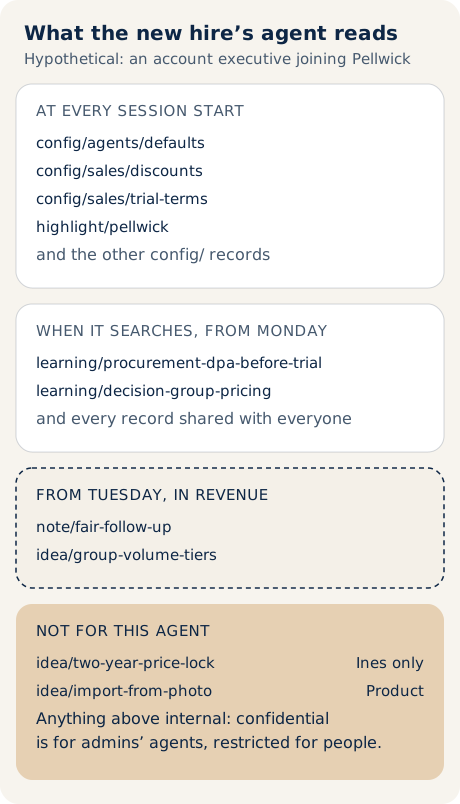
What the new account executive's agent reads at session start, by search, after joining Revenue, and never.
Each of those outcomes was settled weeks earlier, by whoever wrote the record, at the moment of writing. The question for a team is whether that is the right moment to decide.
Every statement has its own readers
A wiki puts its permissions on a page or a space. Notion, for example, gives access per person, group, or teamspace (Notion's sharing and permissions guide). That fits a document someone writes for other people: a handbook chapter has one natural audience, and its author picks it once.
What agents write during the work is smaller and more mixed. Over a few weeks at Pellwick, Tom's ChatGPT chat stores the lesson that a group's procurement wants the data-processing agreement with the trial, which every agent that talks to a clinic should know. Tom also stores an idea of volume tiers, for the people who sell. Lena stores an idea for an onboarding checklist, for the people who build the product. Ines stores the price lock idea, for nobody yet. Four short statements, four audiences, and no page that could hold them under one permission.
So Mana puts the audience on the record. A record is read by its author alone, by a team or a node of the organization, or by everyone in the organization, and the choice is made when the record is stored. An audience never widens on its own. Changing it later is a correction, with a reason, like any other change.
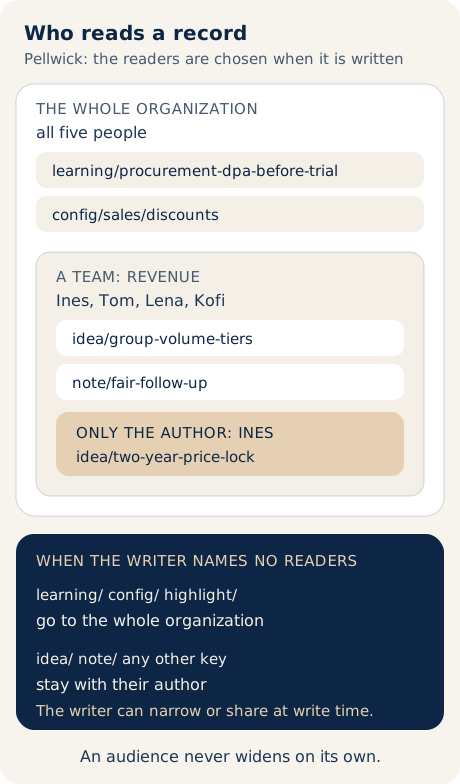
Who reads a record at Pellwick: the whole organization, the Revenue team, or only the author, and the default for each key family.
Defaults that lean toward sharing what was learned
When the writer names no readers, the key decides. A learning (learning/), a group setting (config/), and a highlight (highlight/) go to the whole organization. An idea (idea/), a note (note/), and any other key stay with their author. A person can ask their agent to narrow a learning, or to share an idea with a team, at the moment it is recorded.
The split is a bet on what each family is for. A learning exists so that the next agent does not repeat a mistake, and a lesson kept private by default would stay a lesson for one person. An idea is unfinished, and its author should choose when it travels.
The bet has a cost. A learning about one clinic's contract goes to everyone unless the writer narrows it, and Mana finds a new record by its words as soon as it is stored. A record shared too widely has been readable from that moment. A correction narrows what agents read next. It cannot take back what they already read.
Sensitivity is a second fence, separate from the audience. Each record carries a level: public, internal, confidential, or restricted. Code computes the label at write time. A writer can only raise it, never lower it. A member's agent reads up to internal, an admin's agent up to confidential, and restricted knowledge reaches no agent at all, whatever its audience.
Joining a team is an admin's step
On Tuesday, Ines opens Settings, then Teams, and adds the new account executive to Revenue. Mana issues their access again with the new team and ends the earlier access in the same step, so their agents sign in once more. From the next session, a search for the trade fair finds Kofi's list of warm contacts and who calls each one this week. The Product team's ideas still do not, and the price lock idea still belongs to Ines.
Roles work the same way. The first person of an organization to sign in becomes its admin, and everyone after joins as a member. When an admin changes a role on the Organization page and the sign-in provider reports it, Mana issues the access of the new role and ends the earlier one in one step. The next sign-in of the person's agents carries the new role.
Leaving takes one step. When an admin removes the person on the Organization page and the sign-in provider reports it, Mana ends the person's access and their sign-in, and their agents are refused from the next call. There is no second step in Mana.
A correction keeps the answer it replaces
On 2 September, Maya and Ines decided to build the multi-site view before the leave module, because every clinic group had asked for one view of its sites first. Maya's Claude Code session stored the decision under learning/decision-multi-site-first.
Maya is a member, and a member's agent adds records but does not correct them. So the change went through Ines. On 16 September she corrected the decision under the same key, with the reason "Named the first release date and the two pilot groups." The record now has two revisions. An agent that reads the key gets the second: a first release on 14 October to two pilot groups. The first stays readable in the history, with its date and its author, and the reason sits between them.
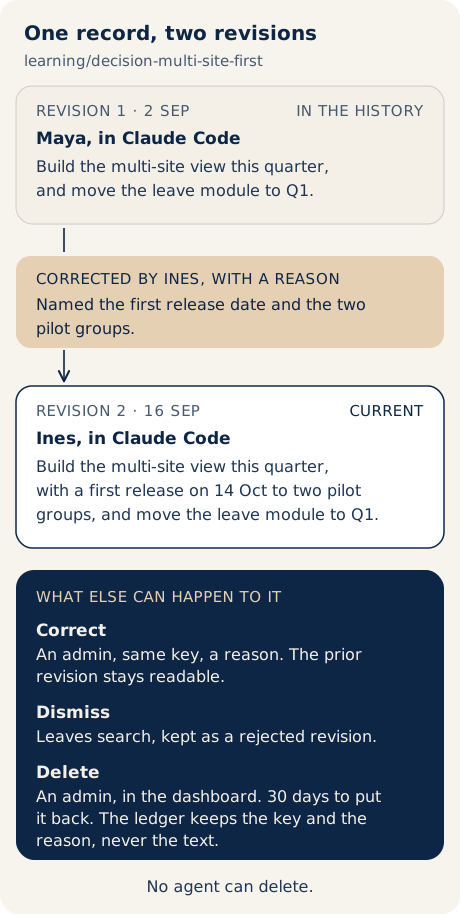
One record, two revisions: the product decision before and after the correction, and what else can happen to a record.
Two smaller rules keep that history worth reading. A correction that repeats the current statement word for word stores nothing, so the history holds only real changes. And retiring a record is a different act from deleting it. A dismissed record leaves search and retrieval and stays in the store as a rejected revision. Deleting is a human act in the dashboard, reserved to an admin, and no agent holds a tool that deletes. A deleted record can be put back for thirty days. After that its text is erased, and the store's hash-chained ledger keeps only that it existed, its key, who deleted it, and when.
Keeping corrections with the admins has an obvious price: Maya knew the release date before the record did, and she had to ask. For a team of five, one accountable person behind what every agent is told is worth that wait. A larger organization will feel the wait sooner, and may want more than one admin.
Seeing who knows what
Readers and corrections decide what the store says. A team also wants to see where its knowledge sits: who has written about procurement, whose agent knows the discount rule. Mana's Graph shows both, and only over what the viewer may read.
The topic map sorts each readable record into a topic of the organization's list. At Pellwick the list is Ines's: six topics, from Sales and deals to How we work, each a name and one sentence. When the map opens, each record goes to the topic nearest its meaning. Nobody tags anything, and Mana stores no label on a record. Every member sees the list, and only an admin changes it.

The topic map of Pellwick: six topics from the admin's list, each sized by its records, with its writers in a ring.
The team map shows the same store by person and agent, and Who knows what gives each person's counts by Library folder. On either map, a person selects up to 20 records, people, or agents and asks for one summary of at most 20 records, with a number on each sentence pointing at the record it came from. Below, Ines selects Lena, Tom, and her own command line, and gets one paragraph from 20 records on what the team promises clinic groups.

Three nodes selected on the team map, and the summary of the 20 records they gave. The viewer is Ines, shown as You, and the solid lines join her to the people whose records she revised.
The map is careful about what it reveals. First names come from the sign-in provider into the browser, and Mana stores no name. A dotted line between two people counts what one of them shared with a team the other may read, and it speaks only of teams you hold yourself.
What this asks of a team
The arrangement moves work to the moment of writing. A writer, or the agent writing for them, has to know who a record is for before it exists, and the defaults help only when the key family matches the intent. An admin answers for every correction and every team. A person's own notes vault is read by that person alone, and a team cannot share one yet.
What it gives back is a store where each record answers for itself. When the new account executive's agent cites the group price on Friday, the citation leads to a record that says who decided, when it changed, why, and who else may read it.
For a team that lets its agents write, the readers of a statement belong in the statement, chosen when it is written, and changing them belongs to someone who has to give a reason. A permission added later to a folder or a page arrives after the agents have read what was in it.
The guides give the exact steps: What to store, and who reads it for audiences and levels, Members and roles for teams, The dashboard for the Graph and Settings, and Your data for dismissing, deleting, and the ledger.